

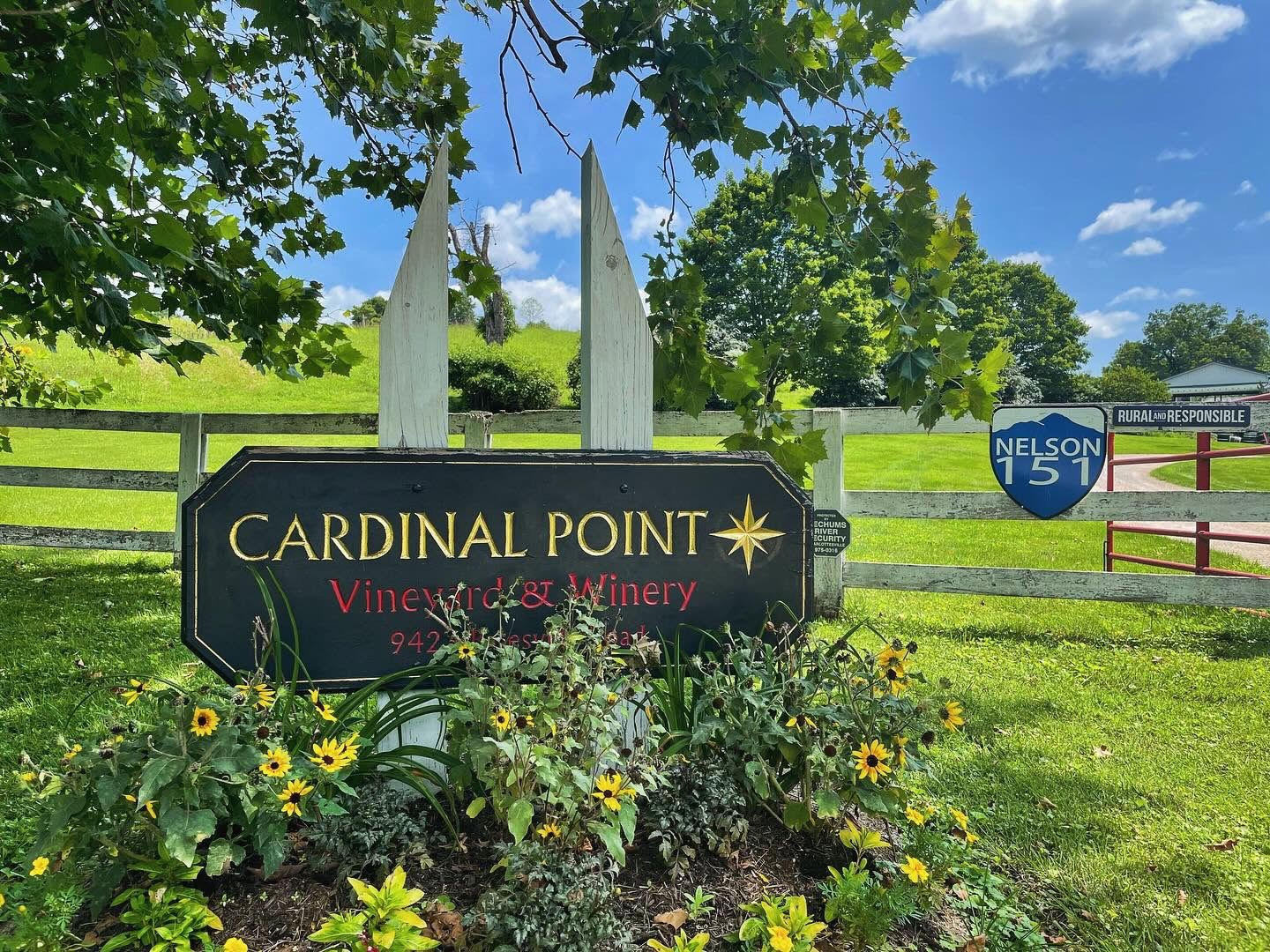
In the spring of 1986, during his senior year at James Madison University, Tim Gorman helped his father plant two acres of Riesling on the family’s farm in Nelson County. Forty years later, about an acre of those original vines still produces a dry Riesling that Tim counts among his favorites at Cardinal Point Vineyard & Winery.
Following graduation, Tim spent a year at a Richmond job he didn’t enjoy before returning to the farm in 1987 to tend the vines. While at a party in Richmond not long after that, a woman asked what he did for a living. He told her that he worked at a vineyard, which she found interesting.
“I kind of liked her,” Tim recalls, “so I kind of played it up.” He and Susan married in 1990, and they’re still at the heart of Cardinal Point today.
The vineyard was his father’s retirement plan. While stationed in Bad Kreuznach, Germany, career Army officer Paul Gorman and his wife, Ruth, fell for the Rieslings made by small family vineyards along the Nahe River. Paul was convinced Virginia could grow grapes, too, at a time when the state had only a handful of wineries. In the early 1980s, the Gormans bought a 90-acre farm near Afton, and it soon became a family project: eldest son John oversaw the renovation of the original farmhouse, while daughter Sarah and Tim tended the vines when they were home from school.
When Susan enrolled at Virginia Tech in 1991 to study horticulture, Tim tagged along and ended up as the only student in the school’s fruit science concentration. Back home with a horticulture degree, he grew the vineyard to about 15 acres and served as president of the Virginia Vineyards Association from 2000 to 2002.
But selling grapes was a precarious business. In 2000, a winery that had agreed to buy his crop took only half, and Tim had to sell the rest of the perishable fruit at a steep discount. The lesson was clear: turning grapes into wine would protect the harvest and add value. In 2002, the family built a winery of its own, with John designing the buildings, Sarah running the business side and Tim as winemaker.
Their wines have since earned a place among Virginia’s best. Cardinal Point’s 2014 Union won the Monticello Cup in 2017, and its 2014 Clay Hill Cabernet Franc was named to the 2016 Virginia Governor’s Case, the 12 top-scoring wines in the state. Most recently, the 2025 Aubaine — an unoaked Chardonnay whose name means “windfall” in French — earned gold at the 2026 Monticello Cup. Tim is refreshingly candid about awards: he enters each wine only once per competition, and a gold is always the goal.
This fall, Cardinal Point is adding wine spritzers on tap and by the glass, in flavors including Sparkling Honey Sangria and Pineapple Bomb.
As part of a series showcasing Nelson 151 members, Tim shares more about what goes into making his award-winning wines and where he goes when he’s not pouring his own.
Why did you choose Nelson County, and what has your experience been as a founding Nelson 151 member?
Tim Gorman: My dad knew he was going to retire and wanted to be a farmer. Our family had lived in Germany, which is where he got the idea about grapes. Back then, in the early 1980s, there were like six wineries in the state. Most of them were up in Northern Virginia, where we used to live. I went to a couple places with my parents, and they were just these tiny places, but my dad was convinced that we could grow grapes.
So he started looking for vineyard property throughout the state. He wanted to be closer to us. My brother had graduated from UVA in ’82, my sister was still there and I was at JMU in Harrisonburg. They put a bid on some land in Rockbridge County, but when my dad and I actually walked the property trying to find the perimeter, it turned out the plat didn’t match what they were selling.
Fortunately, they found this place, about 90 acres in Nelson County. It had the original farmhouse and at least nine outbuildings. He picked it because he thought it was really good vineyard land.
It was pretty good vineyard land; we’ve made it better. There are frost issues (it’s hard not to get frost in this state), so I have wind machines and things like that. We’ve also got great drainage. I’m so glad we ended up in Nelson County. I love it here. My kids have gone through the schools, graduated and are out in the world.
When we got here, there were very few wineries. Part of the reason my sister and I got enough gumption to become our own winery was that Afton Mountain, which we sold grapes to, was here and established. But it was still only one winery, sort of in the middle of nowhere. If you were touring for wine, you had to really go out of your way to visit that one place.
Then Veritas came in. I helped when they were establishing their vines, and then they put up a winery and started selling. I thought that was really cool, and also that two wineries are probably better than one, but three — that’s a wine tour. So we came in, and that made the first three in this little area.
After that, the breweries started coming in: Blue Mountain, Wild Wolf. My idea was that we all put in some seed money and start marketing together, because nobody wants to drive all the way out here to visit one place and then drive back. We’d work on lodging and the tour buses that were starting to come around, which back then were just tiny limos or minivans with four or five people. I figured we’d start with the seed money and it would eventually take care of itself. Well, it turns out we’ve put in $1,000 every year since. It’s definitely been worth it.
At the first meeting I said, “I’m calling it Nelson 151, but we can call it anything you guys want.” The name stuck. Now it’s easy to send people in different directions around the area: Ask where they’ve been, pull up a map and help them figure out where to go next.
What are your favorite offerings at Cardinal Point?
TG: That’s impossible to answer. I like them all for different reasons. I’m not trying to dodge the question, but it depends on my mood, the temperature outside and what food we’re serving.
I do like crisp white wines. I love the dry Riesling. I don’t know that it’s everybody’s favorite, but it’s got bracing acidity. I also love the Aubaine.
The St. Rose is an awesome rosé. We have the ’24 right now, and the ’25 will be released soon. Basically, when we sell out of one vintage, we start pouring the next. I’m really excited for the ’25.
On the red side, our Union is always pretty good. The Petit Verdot does very well, but we’re almost out of that. I’ve had people come up and say, “Hey, you knocked it out of the park with that Tannat.” Tannat is a vinifera grape, mostly grown in southwest France. It usually goes into our Union, but the 2023 was so good we bottled it on its own. It’s 100% Tannat, an interesting chewy, leathery kind of wine. Very unique.
But, you know, they’re all good!
Describe the process behind making your wine.
TG: It starts in the winter with pruning, then we nurture everything through the season. It’s tons of handwork. We pull leaves around the clusters to keep them dry and let the sun get through. We have to spray fungicides; it’s just too tough here, with too much rain.
We pick by hand. For my crew, I rely on the H-2A program. We’re down to three people: two brothers and their mother from Tula, Mexico. On their own, they figured out that they like harvesting at night better than during the day, because it gets too hot. I think that’s awesome, because years ago in California they moved to night harvests, using tractors with big lights.
My guys just put on headlamps and go out and pick. On harvest nights, I put out bins for them, and they show up at some point during the night. I’ll wake up in the morning, come down and find about six bins of fruit, which I put onto a trailer and bring down to the winery.
We’re a gravity-flow winery, which means I never use a pump until it’s juice. Pumping fruit turns it into mush, and it can break the seeds. The seeds are loaded with tannin, but not the good tannin. (The skin tannins are what you’re after, especially with reds, but even whites have tannin.) Think about biting into a seed: It’s suddenly bitter. So you never want to break a seed.
For the whites, I do whole-cluster pressing, so there’s no destemming. For the reds, you destem and let them steep on the skins, because the red color comes from the skins. Then there are a bunch of decisions you make based on the quality of the juice and its turbidity, meaning how cloudy it is.
At some point you add yeast. For the reds, you’re fermenting on the skins. Fermentation is just the yeast converting the sugar into alcohol. I’ve had ferments go shockingly fast, in three days, and I’ve had stuff still actively fermenting three or four months later. Let’s say it’s typically two weeks on average. At that point the juice is wine, and it goes either into barrels or into an inert vessel like stainless steel.
Barrels and stainless steel are all I use. There are other options, but don’t use plastic. It has a ridiculous amount of surface scratches that hold bacteria, and you can never get it clean. Stainless steel is great, or, like I say, barrels. It depends on the style of wine. You can age a wine for a long time in a barrel.
Then it goes into the bottle. We use a bottling line service. A guy comes in with a trailer holding more than half a million dollars’ worth of bottling equipment that he runs and maintains, so I don’t have to worry about knowing how to do any of that. I provide the bottles, labels, capsules, corks, the wine and the crew to work the line, and he makes sure everything runs. That works great.
This year I have no harvest. We lost everything to frost, and the little Tannat that survived got shredded by golf-ball hail. In November, I’ll bottle about 750 [cases] of last year’s wine.
How do you decide which grape varieties will succeed, and which wines to enter in competitions?
TG: Virginia has a fantastic extension service that supports the grape industry, and before I came along they did an exhaustive job figuring out what grows well. Then there were the pioneers who started before me, so there’s a track record of what holds up.
Climate change is changing everything about what does well and what doesn’t. Another variable is that consumer whims change. You can have a perfectly situated site and the fruit does great, but if nobody wants it, that’s tough.
The first thing we put in here was Riesling. Never plant Riesling in Virginia; it’s the dumbest thing to do. Now, having said that, I’ve got a good acre of 40-year-old vines that make a really nice Riesling, and I don’t know how it’s held on. That was all my dad. We had lived in Germany, surrounded by Riesling vines, so he said we’d do that. There wasn’t a lot of thought in it.
Since then, especially after I went to Tech and understood what would work, I try not to grow anything risky, but it’s always a risk. It’s farming. I try to pick what will do well, but I also keep an eye on what I can make with it and what will sell with the public.
I learned about this a few years ago and haven’t been able to implement it yet, but in California they do this: No matter what size your vineyard is, you replace 5% of it every year. That way, every 20 years you’ve got new vines coming in. It could be the same variety you had before, but newer vines. Eventually vines start to wear down, and at 20 years you’re definitely going to see a reduction in production.
As for competitions, it tends to come down to what my tasting room staff says is tasting well, or what I’m particularly proud of. But if I’ve entered a wine once, I won’t enter it again in that same competition.
Part of what makes Nelson 151 so special is its commitment to sustainability and keeping the area scenic and rural. How do your operations fulfill that commitment?
TG: If you look at the Virginia Farm Winery Act, the whole idea was to preserve our agricultural spaces. The alcohol business is tough. The state wants you to be a producer, a wholesaler or a retailer. Those are the three tiers, and you couldn’t be on two. The Farm Winery Act was a law change that allowed farm wineries to be on all three levels, and that was so we could preserve farmland. So that’s one way it’s sustainable.
We’re a solar winery. Every south-facing roof is covered in panels, and we’re almost at [net] zero. The farmhouse we rent out on Airbnb is 100% solar. I also try to get at the invasives as best I can, and we keep all our oaks. We fight erosion, too. No farmer wants to harm their land, so we’re as gentle as we can be.
Besides Cardinal Point, what are your favorite Nelson 151 businesses to visit?
TG: WildManDan Brewery and Afton Mountain are my go-tos. I like Veritas a lot, too. I tend to pick everyone in my neighborhood, including Blue Mountain. Lately I’ve been going to Three Notch’d more than Blue Mountain, mostly because Blue Mountain gets so crowded, and because my son, who now lives in L.A., was bartending there for a while.
So, without saying everybody, I’ll just stop there!
By Holly Butcher Grant